I recently had the joy of seeing Pacific Northwest Ballet perform George Balanchine’s Jewels. This was my fourth time seeing the full-length ballet—Emeralds, Rubies, and Diamonds—I’ve seen the individual sections several other times. It remains one of my favorite ballets of all time (there’s a reason our BelArts studios are named after it!), and I was reminded why I love it so much.
Emeralds
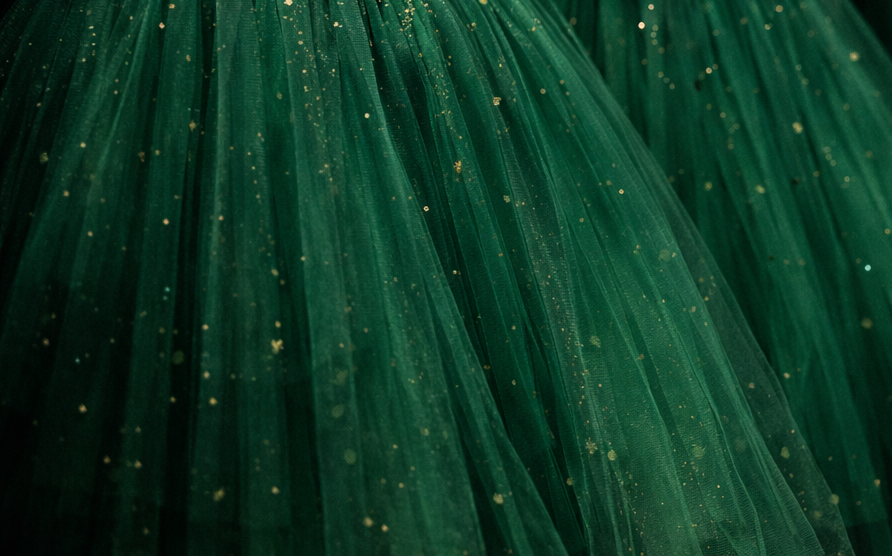
The ballet opens with Emeralds, set to the music of French composer Gabriel Fauré. This “French” section is understated and almost moody, with darker lighting and a rich emerald-green costume palette. Despite its subdued tone, the choreography is lush and full. The dancers wear long romantic-style tutus that match the full arm and leg movements of the choreography.
This is the only section I’ve been lucky enough to perform, and it’s an absolute joy to dance! The steps feel organic and good to dance. It doesn’t feel like a slog or like you are fighting your body to twist into hard and painful shapes. It feels expansive and rich. Emeralds may be the most underrated section of Jewels. It’s less flashy than Rubies or Diamonds, but its subtlety reveals so much depth and texture in the music that is reflected in the dancing. Emeralds is like a layered dip– each time I watch it, I notice something new, even after dancing it myself. I could write a ten-page blog just about Emeralds!
The coda, which was added later, ends on a longing melancholic note that leaves a lasting emotional impression. Throughout playful moments and somber moments, this piece is a real emotional journey that again reminds me of the power of ballet and music to lay out the full range of human emotions. Each time I see it, I feel I can connect to it emotionally in a new way. This is also a good reminder to us as dancers that technique is important, but conveying a feeling or emotion is just as important in a performance.
Next comes Rubies, the “American” section, set to the sharp and witty music of Igor Stravinsky. Every time I hear it, I’m reminded how challenging it is to count—and how critical musicality and listening are in Balanchine’s style/American ballet. The movement is bright, and playful, and almost more pedestrian.
The central pas de deux, created for Patricia McBride and Edward Villella, exudes playfulness and a competitive spark. Villella was originally a boxer and very athletic and the choreography really captures that– you can still feel the presence of those original dancers. Rubies is fast, technical, and tricky—an excellent example of why dancers must practice taking up space, dancing “big” in class, and listening to the music.
Finally, Diamonds closes the ballet. Set to the music of Pyotr Tchaikovsky, it represents the “Russian” section—extravagant and opulent. The dancers wear classical tutus and tiaras, and at first glance the choreography looks more traditional. But especially in the central pas de deux, there are many original takes on some of the more traditional movements. There are many famous pictures captured in the central pas de deux that show a reworking of the traditional aesthetic. The last section involves all the dancers and Balanchine’s trademark genius of moving big groups of people around a stage. It is exciting and rich and full… a modern take on a Sleeping Beauty or Swan Lake.
It is really important for dance students to take advantage of the world-class dance here in the Seattle area. Companies like Pacific Northwest Ballet come to mind, but there is a lot to see here which I think is always inspiring, thought provoking and important for students.